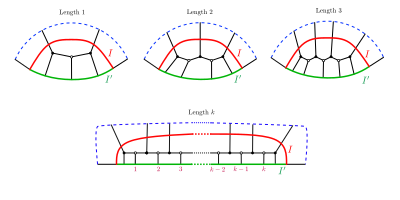
$\mathcal{T} = (\mathbf{\Delta},\Phi)$
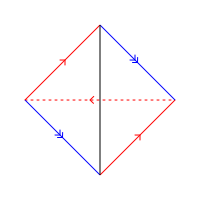
$\mathbf{\Delta}$ is a disjoint union of linear tetrahedra
$\Phi$ is a collection of isomorphisms of pairs of triangular faces
William Hobkirk
The University of Sydney
Geometry and Topology Seminar · 14/10/2026
$\mathcal{T} = (\mathbf{\Delta},\Phi)$
$\mathbf{\Delta}$ is a disjoint union of linear tetrahedra
$\Phi$ is a collection of isomorphisms of pairs of triangular faces
Let $M$ be a $3$-manifold.
The complexity $c(M)$ of $M$ is the minimal $n$ such that there exists a triangulation of $M$ with $n$ tetrahedra.
Minimal triangulations are triangulations that obtain this minimum.
Theorem 6.1, Jaco and Rubinstein (2002)
If $M$ is closed, orientable and irreducible and $M\not\in \{S^3, \mathbb{R}\mathrm{P}^3,L(3,1)\}$ then any minimal triangulation of $M$ must have a single vertex.
Standing assumption: $\mathcal{T}$ has a single vertex.
Orientable $3$-manifolds that admit genus $1$ Heegaard decompositions.
$L(p,q)$ is obtained by identifying two solid tori such that a meridional curve of one is identified with a $(p,q)$-torus knot on the boundary of the other.
The maximum Euler characteristic of a connected non-orientable surface embedded in $L(2n,1)$ is $2-n$.
Jaco, Rubinstein, Tillman (2008)
Proved using canonical non-orientable surfaces realising the non-trivial class of $H_2(L(2n,1);\mathbb{Z}_2)$.
Recipe:
The resulting space is a $\mathbb{Z}_3$-folded surface $X$.
$X$ has a fundamental class $[X] \in H_2(X;\mathbb{Z}_3)$ determined by the orientation of $\text{Int}(X)$.
If $X\subset M$ we say $X$ represents the image of $[X]$ in $H_2(M;\mathbb{Z}_3)$.
Every class in $H_2(M;\mathbb{Z}_3)$ can be represented by an embedded $\mathbb{Z}_3$-folded surface for compact orientable $3$-manifolds $M$.
$\text{Sing}(X)$ is a circle
$\text{Int}(X)$ is an open disk
A function on homology that characterises how complicated the set of realisations of a $H_2(\mathbb{Z}_3)$ class is.
\[\chi_-(X):= \sum_{X_0\in \pi_0(\text{Int}(X))} \max(-\chi(X_0),0)\]
\[ ||x||_{\mathbb{Z}_3} := \max_{[X]=x} \chi_-(X)\]
Generalises the $\mathbb{Z}_2$-Thurston norm.
Determined by the $\mathbb{Z}$-Thurston norm.
Depend only on $\mathcal{T}$ and a $H_2(M;\mathbb{Z}_3)$ class.
$S_{\varphi}(\mathcal{T})$ does not separate the ambient space.
\[\chi_3(x) := \max_{\substack{[X]=x\\ M\setminus X \text{ connected}}} \chi(X) \]
Properties:
Fact: $H_2(L(3n,1);\mathbb{Z}_3) = \mathbb{Z}_3$
Abuse of notation: $\chi_3(L(3n,1)):= \chi_3(x)$ where $x \in H_2(L(3n,1);\mathbb{Z}_3) \setminus \{0\}$.
$\chi_3(L(3n,1))$ is the maximum Euler characteristic of a (non-empty) non-separating $\mathbb{Z}_3$-folded surface embedded in $L(3n,1)$.
Theorem: $\chi_3(L(3n,1))=2-n$ for all $n\in \mathbb{Z}^{>0}$.
Standing assumption: Let $X$ be a non-separating $\mathbb{Z}_3$-folded surface embedded in $L(3n,1)$ of maximal Euler characteristic for some $n\in \mathbb{Z}^{>0}$.
Choose a genus $1$ Heegaard decomposition of $L(3n,1)$ that is "adapted" to $X$.
A Heegaard splitting of $L(3,1)$ that is adapted to a non-separating $\mathbb{Z}_3$-folded surface.
Meridional intersection patterns are $\mathbb{Z}_3$-folded $1$-manifolds properly embedded in a disk.
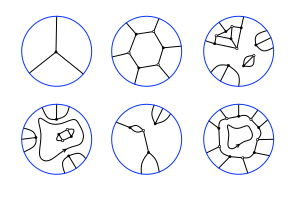
The compressing disk $D$ is embedded such that:
Lemma: If $X$ is a non-separating $\mathbb{Z}_3$-folded surface of maximal Euler characteristic it follows that $\partial D$ bounds a disk in $\text{Int}(X)$
Preserves the Euler characteristic and the property of not separating the ambient space.
The compressing disk $D$ is embedded such that:
Lemma: If $X$ is a non-separating $\mathbb{Z}_3$-folded surface of maximal Euler characteristic it follows that there exists an interval $I$ in $\text{Sing}(X)$ such that the theta graph $I \cup \partial D$ bounds a pair of disks in $\text{Int}(X)$.
Preserves the Euler characteristic and the property of not separating the ambient space.
The compressing disk $D$ is embedded such that:
Preserves the Euler characteristic and the property of not separating the ambient space.
We use the reduced compression surgeries to eliminate all bigons, quads and simple closed curves from the meridional intersection pattern.
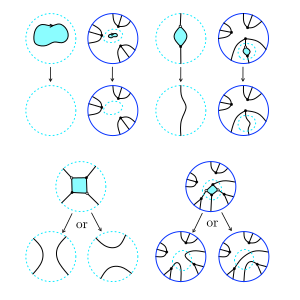
The resulting meridional intersection pattern must admit a subcomplex that looks like one of the following:
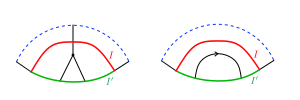
These subcomplexes allow us to reduce the number of meridional disks.
Repeat this process until we have only a single meridional disk in the intersection with the first solid torus.
Meridional intersection patterns can be further manipulated by performing ambient isotopies to the $\mathbb{Z}_3$-folded surface.
Combine these snake moves with the reduced $4$-compression surgery.
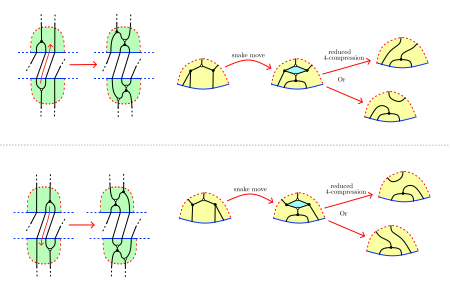
Minimal meridional intersection patterns always have at least one boundary tripod.
Cut the second solid torus along the meridional intersection disk. This gives us a $\mathbb{Z}_3$-folded surface $\tilde{X}$ with boundary properly embedded in a $3$-ball.
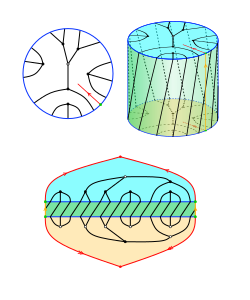
Boundary tripods imply the existence of bigons in the boundary pattern.
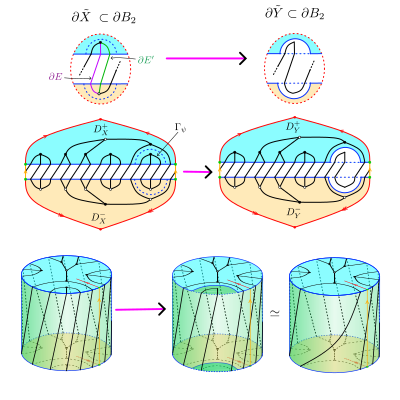
Convert $X \subset L(3n,1)$ into $Y \subset L(3(n-1),1)$ constructively.
Implies that \[\begin{aligned} \chi_3(L(3n,1))+1 &= \chi(X)+1 \\ &= \chi(Y) \\ &\leq \chi_3(L(3(n-1),1)). \end{aligned}\]
By induction, \[\begin{aligned} \chi_3(L(3n,1)) &\leq \chi_3(L(3,1))+1-n \\ &= 2-n. \end{aligned}\]
We will show that $\chi_3(L(3n,1))\geq 2-n$ by example.
Here is a family of particularly nice meridional intersection patterns.
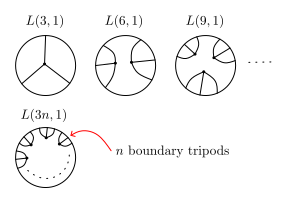
A family of non-separating $\mathbb{Z}_3$-folded surfaces with these meridional intersection patterns.
What does this have to do with triangulation complexity?
Let's prove that $c(L(3n,1))\geq n$.
Let $\mathcal{T}$ be a minimal one-vertex triangulation of $L(3n,1)$ where $n\geq 2$.
Let $X$ be a canonical $\mathbb{Z}_3$-folded surface.
Partition the edges of $\mathcal{T}$ into
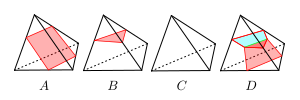
$X$ has the same Euler characteristic as its complement.
The complement of $X$ deformation retracts onto the subcomplex spanned by the even edges.
Hence $\chi(X) = 1-\mathfrak{e} +\frac{B+4C}{2}-C$
In particular $\chi(X)\geq 1-\mathfrak{e}$
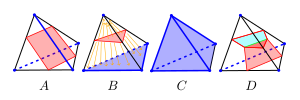
$X$ is non-separating so
\[\chi(X) \leq \chi_3(L(3n,1))= 2-n\]
Hence
\[1-\mathfrak{e} \leq \chi(X) \leq 2-n\]
\[ \Rightarrow \mathfrak{e} \geq n-1\]
$\mathfrak{o}> 0$ since $X$ is non-empty.
$\mathfrak{o}= 1$ implies that a $\mathbb{Z}_3$-crosscap embeds in $L(3n,1)$.
This is impossible since $\chi_3(L(3n,1))\leq 2-n \leq 0$.
\[\mathfrak{o} \geq 2\]
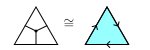
$L(3n,1)$ is closed so $\chi(L(3n,1)) = 0$
Counting cells of $\mathcal{T}$ we have:
\[1-\mathfrak{e}-\mathfrak{o}+\frac{4c(L(3n,1))}{2}-c(L(3n,1)) = 0\]
$\Rightarrow c(L(3n,1)) = \mathfrak{e}+\mathfrak{o} - 1$
$\hspace{6em} \geq (n-1) + (2) - 1$
$\hspace{6em} \geq n$
Follows from fancier arguments, analysing edges of low degree in minimal triangulations.
Implies that the minimal layered triangulations of $L(3n,1)$ are minimal triangulations (conjecture of Jaco and Rubinstein, 2006).
This proof will be on Arxiv before the next batch of results from OpenAI.
William Hobkirk · [email protected]