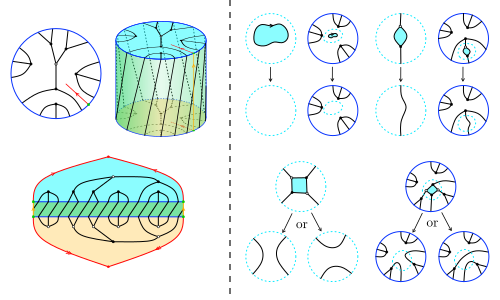
The generalised compression surgeries correspond to certain moves on the intersection patterns of $\mathbb{Z}_3$-folded surfaces.
Hello! I am Will Hobkirk, a PhD candidate at The University of Sydney.
My supervisor is Jonathan Spreer.
My research focus is in Algebraic and Geometric Topology. My favourite things are $\mathbb{Z}_p$-folded surfaces. Here is a little introduction. If you would like more information please send me an email! You can also check out my University Page.
Here are slides from a talk on $\mathbb{Z}_3$-folded surfaces and the complexity of lens spaces.
Here is my paper $\mathbb{Z}_p$-folded surfaces and the $\mathbb{Z}_p$-Thurston norm.
Here is a short note I coauthored on something called a Magic Braid.
Lens spaces are a family of 3-manifolds obtained by identifying the boundaries of two solid tori. The Lens space $L(p,q)$ where $\gcd(p,q)= 1$ is given by identifying the solid tori such that the meridional curve of one solid torus is identified with a $(p,q)$-torus knot on the boundary of the other solid torus.
$S^3 = L(1,0)$
$S^1 \times S^2 = L(0,1)$
$\mathbb{R}\text{P}^3 = L(2,1)$
$L(7,2)$
The Lens spaces $L(2n,q)$ have a non-trivial $H_2(\mathbb{Z}_2)$ which is realised geometrically by a non-orientable surface $X$ embedded in $L(2n,1)$ which does not separate the embedding manifold (equivalently $X$ is connected). The maximum Euler characteristic of such a non-orientable surface embedded in $L(2n,1)$ is $2-n$ by a result of Bredon and Wood. When $n=1$ this essentially says that $\mathbb{R}\text{P}^2 \subset \mathbb{R}\text{P}^3$. This embedding looks like:
The embedding of $\mathbb{R}\text{P}^2 \subset \mathbb{R}\text{P}^3$.
The maximum euler characteristic connected non-orientable surface that embeds in $L(4,1)$ is the Klein bottle. $\mathbb{R}\text{P}^2$ does NOT embed in $L(4,1)$.
The maximum euler characteristic connected non-orientable surface that embeds in $L(6,1)$ has non-orientable genus of $3$. $\mathbb{R}\text{P}^2$ and the Klein bottle do NOT embed in $L(6,1)$.
What is the correct object to realise the non-trivial $H_2(\mathbb{Z}_p)$ classes of the Lens spaces $L(pn,q)$? The answer: $\mathbb{Z}_p$-folded surfaces. A $\mathbb{Z}_p$-folded surface is an oriented folded surface in the sense of Turaev where the orientation of the interior induces a consistent orientation along each component of the singular locus and the index of every component of the singular locus is p.
A singular point in a $\mathbb{Z}_3$-folded surface with a neighbourhood homeomorphic to $K_{3,1} \times \mathbb{R}$ satifying orientation constraints.
A point in a $\mathbb{Z}_5$-folded surface with a neighbourhood homeomorphic to $K_{5,1} \times \mathbb{R}$ satifying orientation constraints.
The maximum Euler characteristic of a non-separating $\mathbb{Z}_3$-folded surface in the Lens space $L(3n,1)$ is $2-n$. The following is this $\mathbb{Z}_3$-folded surface $X\subset L(3,1)$ of Euler characteristic $1$.
This is the non-separating $\mathbb{Z}_3$-folded surface $X\subset L(3,1)$ of Euler characteristic $1$.
This is the non-separating $\mathbb{Z}_3$-folded surface $X\subset L(6,1)$ of Euler characteristic $0$.
This is the $\mathbb{Z}_3$-folded surface $X\subset L(9,1)$ of Euler characteristic $-1$.
One part of the proof involved a generalisation the notion of a compression surgery to define the following surgeries of $\mathbb{Z}_3$-folded surfaces.
The usual notion of a disk compression of a surface.
A $2$-compression of a $\mathbb{Z}_3$-folded surface (before and after).
A $4$-compression of a $\mathbb{Z}_3$-folded surface (before and after).
The rest of the proof involves the combinatorics of intersection patterns of $\mathbb{Z}_3$-folded surfaces with the splitting torus and a meridional disk of one of the two solid tori in the genus $1$ Heegaard decomposition of $L(3n,1)$.
The generalised compression surgeries correspond to certain moves on the intersection patterns of $\mathbb{Z}_3$-folded surfaces.
We also require a snake move which is an isotopy of a $\mathbb{Z}_3$-folded surface that affects its intersection pattern:
Before
After
The snake isotopy that induces snake moves on intersection patterns.
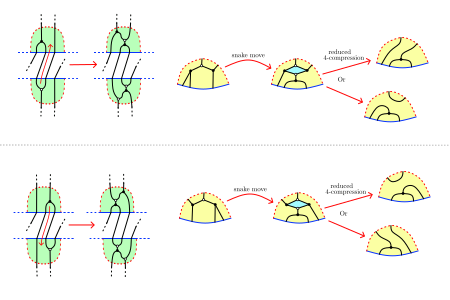
The operations on intersection patterns induced by the snake moves.
These $\mathbb{Z}_p$-folded surfaces are a new object but they contain a lot of information about the triangulations of $3$-manifolds due to the existence of canonical $\mathbb{Z}_p$-folded surfaces
The elementary pieces of a canonical $\mathbb{Z}_3$-folded surface (up to symmetries of the tetrahedron).
With very little work this can be used to show that the complexity of $L(3n,1)$ is at least $n$. We can surely do better...
The elementary pieces of a canonical $\mathbb{Z}_5$-folded surface (up to symmetries of the tetrahedron).